
Commercial Roof Repair Questions in Florence
Find Out What Your Roof Needs Before Anyone Climbs the Ladder
Answers to commercial roof repair questions in Florence, from split seams and backed-out screws to permits, winter work, and taxes.
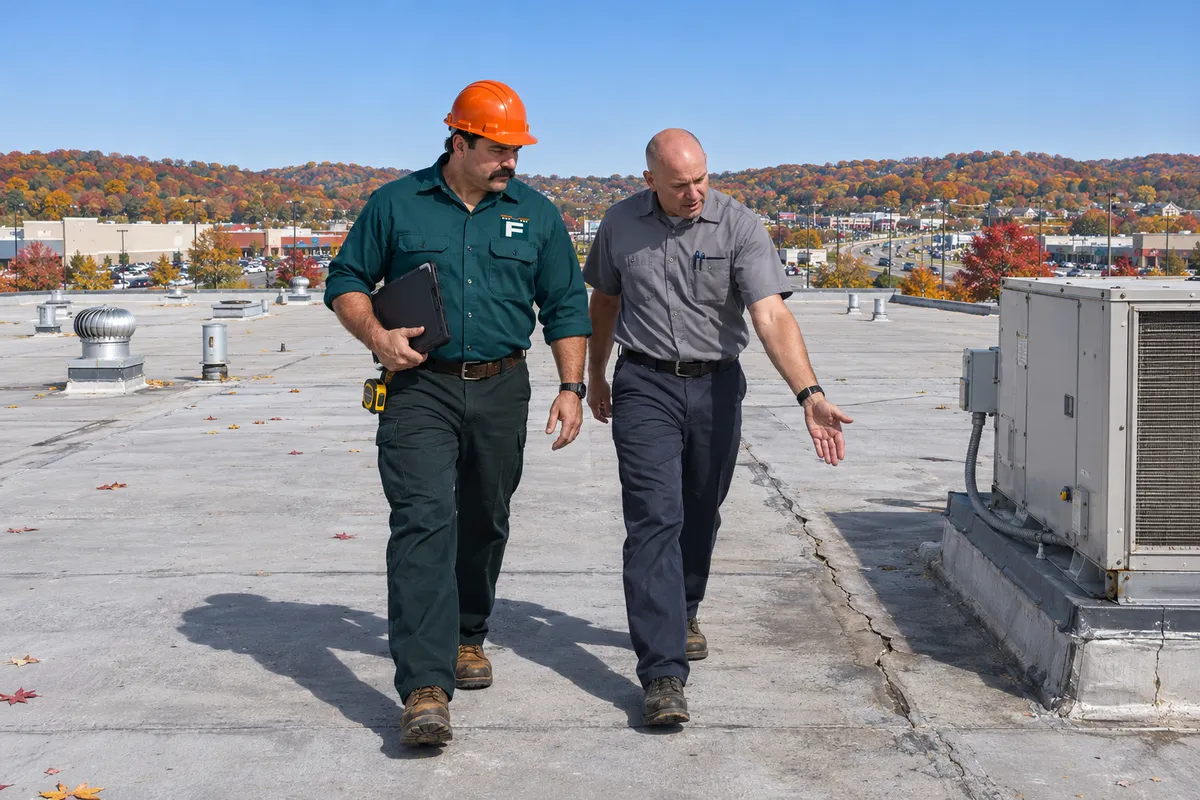
Commercial Roof Repair Questions in Florence, by Topic
Commercial roof repair questions in Florence come up most around the topics below.
Commercial roof repair is the work of finding and fixing leaks, split seams, failed flashing and worn metal on business, industrial and farm buildings. Florence Commercial Roof Repair fixes flat, metal and industrial roofs and traces leaks for owners across Florence and surrounding towns in Boone County, Kentucky, keeping the existing roof in service where its condition allows.
Commercial Roof Repair Basics
What kinds of damage does commercial roof repair fix?
Commercial roof repair fixes the specific spots where water gets in or the roof surface has broken down, while the rest of the roof stays in place. Typical repair items on Florence-area buildings:
- Open seams on TPO, EPDM and PVC membranes
- Punctures from tools, foot traffic or hail
- Loose flashing at parapet walls, curbs and skylights
- Clogged or cracked drains, scuppers and gutters
- Backed-out screws and rusted end laps on metal panels
- Cracked pitch pans and pipe boots
Each repair starts by checking whether water has already reached the insulation underneath, since wet boards spread the problem.
When should a commercial roof be repaired, restored or replaced?
Repair fits a roof with dry insulation and a handful of problem spots, restoration fits a worn surface over a dry core, and replacement fits a roof with wet insulation or failure across most of its area.
| Path | Roof condition | Work involved |
|---|---|---|
| Repair | Isolated leaks, a few open seams or loose flashing | Fix each spot with matching materials |
| Restore | Aged surface, many small defects, dry insulation | Repair all defects, then add a new surface layer |
| Replace | Wet insulation, deck damage, widespread seam or panel failure | Remove and rebuild the roof system |
A moisture survey is the dividing line. Once a large share of the insulation holds water, patching the membrane over it keeps the damage hidden.
Is a temporary roof patch enough, or does it need a permanent repair?
Temporary patches stop water during a storm or until weather allows proper work, and nearly every one needs a permanent repair afterward.
| Factor | Temporary patch | Permanent repair |
|---|---|---|
| Materials | Roof cement, tape, sealant | Membrane, flashing or metal matched to the roof |
| Surface prep | Minimal, often on a wet surface | Cleaned, dried and primed |
| Bond | Holds for a short time | Welded, taped or fastened per manufacturer details |
| Effect on later work | Asphalt cement can block welding on TPO and PVC | Ties into the roof for future repairs |
Asphalt-based patches on single-ply membranes have to be cut out before the permanent repair, so the cleanest temporary fix uses tape or a compatible sealant.
How often should a commercial roof be checked for damage?
Twice a year, in spring and fall, plus after any storm with high wind or hail, is the usual inspection rhythm for a commercial roof. Spring checks catch winter damage from ice at gutters and freeze-thaw cracks at sealant joints. Fall checks clear leaves from drains and scuppers before snow.
A short checklist covers most roofs:
- Seams and laps along the field
- Flashing at walls, curbs and penetrations
- Drains, strainers and overflow scuppers
- Edge metal and coping joints
- Interior ceilings for new stains
Photos from each walk give a baseline to compare after the next storm.
Flat Roof Repair Questions
How are split seams repaired on a TPO, EPDM or PVC flat roof?
A split seam gets cleaned to fresh membrane and closed with heat welding on TPO and PVC or with primer and cover tape on EPDM. Dirt, chalking and old sealant come off first, because a weld or tape bond over residue lets go again.
On older TPO, the weathered surface gets scrubbed with a membrane cleaner before a test weld. When a seam will not take a weld, a cover strip goes over the whole seam instead.
EPDM seams that opened from old splice adhesive get a new strip of seam tape centered over the lap. A probe along the repaired length confirms a full bond.
What causes blisters on a flat roof, and do they need repair?
Blisters form when air or moisture trapped between roof layers expands in summer heat and lifts the surface. They show up most on built-up and modified bitumen roofs, and less often on adhered single-ply membranes.
Small, intact blisters are watched rather than cut. A blister needs repair once it cracks, grows, or sits where foot traffic will break it.
Crews cut it open, let the layers dry, adhere them back down, and patch over the cut with matching material. If the blister held water, the insulation around it gets a moisture check before the patch goes on.
How do you fix ponding water on a flat roof?
Ponding on a flat roof gets fixed by finding why water sits there, then clearing or adding a path to a drain or scupper. The first check is the drain itself, since a clogged strainer or a drain set too high causes many ponds.
Other fixes, from smallest to largest:
- Clearing debris and leaves from strainers and scupper boxes
- Lowering a drain sump with tapered insulation around the bowl
- Building a small cricket to push water past an RTU curb
- Adding a drain or scupper at the low area
Dirt rings and algae mark the edges of a pond, which shows its size between rains.
Can punctures and tears in a flat roof membrane be patched?
Punctures and tears in TPO, EPDM and PVC get patched with a piece of matching membrane that extends a few inches past the damage on every side, with rounded corners so the edges resist peeling.
Before patching, crews press around the hole to feel for soft, wet insulation. Wet boards under a puncture get cut out and replaced, or the patch traps water that spreads under the membrane. Punctures cluster along service paths to RTUs and near ladders and hatches, so walkway pads often go in with the repair to protect the same spot.
Why does a flat roof leak around drains and scuppers?
Flat roofs leak at drains and scuppers because water collects there, and any gap in the membrane seal or flashing gets constant exposure. At a drain, the usual culprits are a loose or missing clamping ring, a cracked drain bowl, or membrane that pulled away from the flange.
Scupper leaks start at the corners of the metal box where it passes through the parapet wall, where sealant dries and cracks. Gutters fed by scuppers back up when downspouts clog, pushing water over the box. Repair resets the clamping ring, reflashes the box corners, and clears the line down to the downspout.
Commercial Metal Roof Repair Questions
What makes metal roof screws work loose, and how is that repaired?
Screws on exposed-fastener metal roofs work loose as the panels expand in heat and shrink in cold, which slowly wallows out the hole in the purlin. Rubber washers under the screw heads also harden and crack with sun exposure.
Repair crews check fasteners row by row along each purlin line. A loose screw comes out and an oversized screw with a fresh washer goes into the same hole for a tight bite.
Screws that missed the purlin entirely get pulled and the hole sealed. Stitch screws along side laps get the same check, since laps leak when those small fasteners loosen.
How are rusted panels and end laps repaired on a commercial metal roof?
Rusted end laps and panels get cleaned to firm steel and sealed with butyl tape or lap sealant, while panels with holes rusted through get patched or swapped out. End laps rust first because water wicks between the overlapping sheets and sits there.
Light surface rust gets wire-brushed and primed. Holes smaller than a hand get a metal patch set in sealant and fastened at the edges. Larger rust-through near the eave or along a gutter line means cutting out that section or replacing the full panel. New panels match the rib profile and finish of the old ones, so laps nest tightly.
How does repairing a membrane roof differ from repairing a metal roof?
Membrane repairs bond new material to the existing sheet, while metal repairs center on fasteners, laps and sealants that let steel move.
| Repair item | Membrane roof | Metal roof |
|---|---|---|
| Open joint | Re-weld or re-tape the seam | Reseal the side or end lap and add stitch screws |
| Hole | Round-cornered membrane patch | Metal patch in sealant, or new panel |
| Penetration | Pre-formed boot welded or taped in | Flexible boot shaped to the ribs |
| Edge | Reattach membrane to edge metal | Refasten eave trim and gutter straps |
| Main material check | Wet insulation under the sheet | Rust at laps and purlins |
Both roof types need repairs made with materials the existing roof accepts, since mismatched products peel or corrode.
How are leaking gutters, eave trim and ridge cap fixed on a metal building?
Gutter, eave trim and ridge cap leaks get fixed by resealing joints, refastening loose pieces, and replacing sections that have rusted through. Gutters on metal buildings leak at seams between sections, at end caps and where downspouts attach.
Ridge cap leaks start where foam closures under the cap have crumbled or birds have pulled them out, letting wind push rain under the cap.
Repair replaces the closures, reseals the cap laps, and swaps any screws that have lost their washers. Eave trim gets refastened where wind has loosened it, because a flapping trim piece tears its own fastener holes larger.
How is flashing at walls and rooftop curbs repaired on a metal building?
Flashing leaks on a metal building are repaired by refastening or replacing the bent metal pieces where panels meet a wall or curb, then resealing them with closures and butyl tape. These joints move with the panels, so their sealant cracks first.
| Spot | What fails | Repair |
|---|---|---|
| Headwall | Loose flashing, crumbled closures | New closures, refastened flashing and fresh butyl |
| Sidewall | Open joint along the last panel rib | Reset the flashing over the rib and seal its laps |
| RTU curb | Water damming on the upslope side | Add or rebuild a cricket and reseal the curb flange |
Leaks that return at the same wall after several repairs point to flashing lapped the wrong way from the start. Replacing that run of flashing, with laps shingled downhill, ends the cycle.
Commercial Roof Leak Repair Questions
How do roofers trace a commercial roof leak to its source?
Tracing a commercial roof leak starts inside, where crews mark every drip and stain, then moves to the roof directly above and uphill of each one. Water can run along deck flutes, insulation joints and purlins before falling, which often puts the entry point several feet from the drip.
On the roof, crews check the seams, flashing, curbs and penetrations nearest each marked spot. When the source still hides, controlled water testing runs a hose on one detail at a time while someone watches from inside. Infrared scans or moisture meters show where wet insulation spreads, which narrows the search on large roofs.
Where do leaks usually start on different commercial roof types?
Leaks start at the joints and openings on every roof type, and each system has its own weak spots.
| Roof type | Common leak sources |
|---|---|
| TPO and PVC | Unwelded seam sections, flashing at corners, punctures near RTUs |
| EPDM | Seams with old splice adhesive, shrinking flashing at parapets, pipe boots |
| Modified bitumen and built-up | Blisters, open laps, cracked flashing at walls |
| Exposed-fastener metal | Screw washers, end laps, ridge cap closures |
| Standing seam metal | Seam ends, penetrations through panels, ridge transitions |
Rooftop units, skylights and drains are leak points on all five. Those details make up a small part of the roof area and a large share of the leaks.
Why does a leak show up far from where water enters the roof?
Water runs along the roof structure before it drips, so a stain inside can sit well away from the hole above. On steel decks, water travels in the flutes until it finds a seam or fastener to drop through. On metal buildings, it runs down purlins and along insulation facing.
Insulation also soaks up water and releases it slowly, which is why a ceiling can drip days after rain stops. Wind-driven rain enters at walls, coping and counterflashing only during storms from one direction. Matching drip timing to wind and rain direction helps point crews toward the right parapet or curb.
How should a facility manager respond when a commercial roof starts leaking?
A facility manager's first move during a leak is protecting people, stock and equipment inside, then recording what is happening for the repair crew. Useful steps:
- Move inventory and electronics away from the drip
- Set buckets and plastic sheeting under active leaks
- Mark ceiling tiles that show stains
- Photograph each drip with the time and weather
- Check from a safe spot whether drains or scuppers are backed up
Walking a wet roof in a storm risks falls and lightning, so roof checks wait until the weather clears. The notes and photos make the leak trace faster.
How are leaks at pitch pans, pipe boots and RTU curbs fixed?
Pitch pans, pipe boots and RTU curbs leak when their fill, sealant or flashing breaks down, and repair rebuilds the seal around each one. Pitch pans dry out and shrink away from the pipe or support inside them, leaving a gap where the pipe exits.
Repair options by detail:
- Pitch pans get refilled with pourable sealer, or swapped for a pre-formed boot where the shape allows
- Pipe boots with cracked collars get replaced and the clamp retightened
- RTU curbs get new base flashing where it pulled loose at the corners
- Condensate lines get rerouted when they drip onto the curb flashing
Curbs also need a check on the upslope side, where water backs up against the unit.
Industrial Roof Repair Questions
How are industrial roof repairs scheduled around plant operations?
Industrial roof repairs get scheduled with plant management around shifts, production runs and safety rules, with work zones planned before crews go up. Areas over sensitive processes, clean rooms or electrical rooms get first priority when they leak.
Planning covers several items:
- Hot work permits for torches or heat welders near flammable dust
- RTU and exhaust fan lockouts while crews work at their curbs
- Roof access routes that avoid production traffic
- Material lifts timed outside truck dock rush hours
Small repairs over active lines often happen during scheduled shutdowns or weekend hours.
What roof damage is common around exhaust fans and process equipment?
Exhaust fans and process equipment on industrial roofs cause softened or swollen membrane, rusted curbs, and cracked flashing where heat, grease or chemicals land. Fans that discharge oils leave stained, spongy areas on TPO and EPDM around their base.
Vibration from fans and compressors loosens fasteners in curb flashing and opens sealant joints. Condensate and process drips run across the membrane toward drains, wearing a path. Repair replaces damaged membrane with a resistant patch, rebuilds flashing at the curb, and adds containment or pads where discharge lands.
How are skylights and smoke vents repaired on industrial roofs?
Skylights and smoke vents leak at their curb flashing, at the seal between the lens and frame, and through cracked or aged lenses. Repair starts with a look at the curb, since most leaks come from flashing that pulled away at the corners.
Crews reflash the curb into the membrane or metal panels, reseal frame joints, and replace cracked lenses with units that fit the frame. Smoke vents also get a check that the hatch opens and seals, because a warped lid leaks around its gasket. Fall protection screens or guards over skylights stay in place during the work.
How do roofers repair foot traffic damage on busy plant roofs?
Foot traffic damage on plant roofs gets repaired by patching punctures and worn membrane along service paths, then adding walkway pads so the same areas stop wearing. Paths to RTUs, exhaust fans and ladders show scuffs, small punctures and crushed insulation under the membrane.
Crushed cover board leaves soft dips that hold water and tear sooner. Repair cuts out the damaged area down to firm insulation, replaces the boards, and patches the membrane. Walkway pads then get welded or adhered along the path, marking where maintenance crews should walk.
What records help keep industrial roof repairs on track over time?
A roof map with every repair, leak and inspection marked keeps industrial roof repairs on track, because large roofs hide patterns that a single visit misses. Each entry notes the location, date, cause and materials used.
Over a few years, the map shows which curbs, drains or seam lines keep failing. That points to a fix at the source, such as a cricket behind an RTU or a new drain sump. It also shows how much of the roof holds repairs, which feeds the decision on restoration or replacement.
Plant engineers often keep the map with their equipment records.
More Florence Commercial Roof Repair Questions?
Call with the roof type and what you are seeing, and we will answer it for your building.
(859) 205-4037Weather, Permits and Codes in Florence
What should be checked on a Florence roof after a hail or wind storm?
After a hail or wind storm, a Florence roof needs checks at its edges, membrane surface and rooftop equipment, where storm damage concentrates. Wind lifts edge metal and coping at corners first, and peeled edges let the next storm get under the membrane.
Hail bruises single-ply membranes and dents metal panels, skylights and RTU housings. Bruised membrane can look fine and crack weeks later, so crews press suspect spots and check the insulation under them. Photos with dates, close-ups of damage and wide shots of the roof help with any insurance claim and set a record for later comparison.
Do commercial roof repairs in Florence need a permit?
Questions about permits for roof repairs in Florence go to the Boone County Building Department, the office Kentucky's Boone County contact sheet names for the cities of Florence, Union and Walton plus the unincorporated county. Small repairs to seams and flashing differ from deck or structural work, and the county decides which jobs need a permit.
| Town | County | Where to ask about repair permits |
|---|---|---|
| Florence | Boone | Boone County Building Department |
| Burlington | Boone, unincorporated | Boone County Building Department |
| Hebron | Boone, unincorporated | Boone County Building Department |
| Warsaw | Gallatin | Kentucky Department of Housing, Buildings and Construction |
| Ghent | Carroll | Carroll County office or the state inspector |
Deck replacement and work at structural framing are the repair items to raise first.
Why do roof repairs slow down during a Northern Kentucky winter?
Winter in Northern Kentucky slows roof repairs because sealants, primers and adhesives need warmer, dry surfaces to bond, and frost or snow covers the work area many mornings. Repairs still go ahead on clear days with cold-weather products and heat welding on TPO and PVC.
Ice causes its own repairs. Freeze-thaw cycles crack sealant at coping joints and curb flashing, and ice in gutters and scuppers backs water under edge metal. Snow piled against parapet walls melts slowly into any gap in the flashing. Clearing drains before a freeze and marking known leak spots before snowfall keeps winter repairs smaller.
Does Kentucky's building code apply to commercial roof repairs?
The Kentucky Building Code covers commercial roof work statewide, and 815 KAR 7:120 adopts the 2015 International Building Code with Kentucky amendments as that code. Florence, Warsaw and Ghent buildings all fall under the same state code, enforced by the local or state office for each county.
Its roofing chapter covers flashing, drainage and reroofing details that repairs tie into. A repair that replaces deck, adds rooftop equipment, or covers a large share of the roof can move into reroofing rules, which the permit office reviews. The state revises the regulation, so the office confirms the edition in force.
Cost, Value and Taxes
What affects the price of a commercial roof repair?
Leak tracing time, wet material removal and roof access set the price of a commercial roof repair more than anything else. A clean seam repair costs far less than a leak that has soaked insulation across a bay.
Main price factors:
- Hours spent tracing, including water testing
- Wet insulation and deck sections to replace
- Membrane or metal type and its matching materials
- Number of curbs, boots and pitch pans involved
- Roof height, access and lift needs
- Weather delays and after-hours work around operations
An inspection sizes each factor before work starts.
When does repeated repair spending stop making sense?
Repeated repairs stop making sense once new leaks keep appearing in different places and the insulation under the membrane or panels is getting wetter. Each visit then fixes symptoms on a roof that is failing as a whole.
A roof map of past repairs shows the pattern quickly. Repairs clustered at one curb or drain point to a fixable detail. Repairs scattered across seams, laps and flashing over the whole roof point to restoration or replacement. A moisture survey and a look at total repair spending over recent years give owners the numbers to compare paths.
How are commercial roof repair costs handled at tax time?
A CPA decides whether roof repair costs on business property count as a deductible repair or a roof improvement that gets capitalized. That line turns on scope, such as patching a seam versus replacing a large roof section.
Roofs on nonresidential buildings are listed as qualified real property for Section 179 in IRS Publication 946, with a 2026 limit of $2,560,000 that phases out above $4,090,000 of qualifying purchases. Keep invoices that describe each repair location, such as drains, curbs or panel runs, plus before and after photos.
Questions by Town
Do Florence roof repairs go through the city or the county?
Roof repair permits for Florence buildings go through the Boone County Building Department, and the city's business guidance sends owners to the county for building permits. The county's Building Inspection department handles plan review and inspections.
Owners call the county with the scope of work, such as reflashing an RTU curb, replacing a section of steel deck, or swapping rusted panels. Structural work and larger sections of roof are the items that bring a permit question. Seam and flashing patches are the routine end of repair work and get described the same way when asking.
How should a Florence building between tenants handle roof leaks?
Leaks in a Florence building between tenants get fixed before the next tenant moves in, since the City of Florence requires a fire inspection and a Boone County building permit for a change of occupant or use. Stained ceiling tiles and wet carpet raise questions during that walkthrough.
An empty building also makes leak tracing easier, because crews can see every ceiling and move freely inside. Fixing drains, curb flashing and open seams while the space sits vacant avoids working over a new tenant's stock.
How should Florence owners document roof damage for an insurance claim?
Florence owners document roof damage with dated photos from inside and on the roof, taken before any repair covers the evidence. Wide shots show where damage sits on the roof, and close-ups show torn membrane, lifted edge metal, dented panels or cracked skylights.
Notes on the storm date, the first leak, and every interior area affected help the adjuster connect damage to the event. Temporary patches go on to stop water, with photos taken before and after. The insurance carrier sets its own rules on reporting time and inspections, so owners check their policy early.
Where do Burlington owners ask about permits for roof repairs?
Burlington owners ask the Boone County Building Department about repair permits, since Burlington is the unincorporated county seat with no city building office of its own. Zoning questions, such as screening for new rooftop units added during a repair, go to the Boone County Planning Commission.
Older churches, offices and shop buildings around the county seat often carry a mix of roof types, such as a flat section behind a parapet next to a pitched metal roof. The joint between them, where membrane meets panels at a wall or curb, is a common place to trace a leak.
What makes roof repairs on Hebron freight buildings different?
Hebron freight and logistics buildings near CVG need roof repairs that work around continuous operations, wide roofs and conveyor lines underneath. The state identified the airport as a major freight site with its 2017 announcement of the Amazon air cargo hub there.
A leak over a sort floor or conveyor stops work on the floor, so repairs on those zones come first. Crews protect the floor, then trace the leak along long seam runs and drain lines.
Tall lifts and cranes close to the runways raise an FAA or airport notice question. Wind across open ground near the runways also limits when membrane can be laid.
How do Warsaw roof repairs work with state permits and river weather?
Roof repairs in Warsaw that need a permit go to the Kentucky Department of Housing, Buildings and Construction, because the Gallatin County contact sheet lists the state as the office for commercial work in the county. Routine seam and flashing repairs get confirmed with that office before work.
Warsaw sits on the Ohio River, and morning fog and dew keep roofs wet, which delays sealant, primer and adhesive work until the surface dries. Crews often start repairs later in the morning there. The co-op serving Gallatin County is Owen Electric, according to East Kentucky Power Cooperative, which matters when a repair needs power shut off to an RTU.
Which other towns around Florence does the repair work cover?
Florence Commercial Roof Repair also works in these towns around Boone, Gallatin and Carroll counties.
| Town | County | Local note |
|---|---|---|
| Union | Boone | City permits go through the Boone County Building Department |
| Petersburg | Boone, unincorporated | Ohio River floodplain parcels can need a state floodplain permit for new construction |
| Richwood | Boone, unincorporated | Boone County Building Department |
| Oakbrook | Boone, unincorporated | Boone County Building Department |
| Francisville | Boone, unincorporated | Near CVG; tall lifts can need FAA notice |
| Ghent | Carroll | Local inspector covers Carrollton only, per the Carroll County contact sheet; check with Carroll County |
| Sparta | Gallatin | State permits through the Kentucky Department of Housing, Buildings and Construction |
Leak tracing, seam and flashing repair, and storm checks follow the same steps in every town.
Getting Started
How do I set up a roof leak inspection in Florence?
Setting up a roof leak inspection in Florence starts with a description of the leak and the building, which helps the crew bring the right materials. Owners share the building address area, the roof type if known, and where water shows up inside.
The visit covers the interior leak spots first, then the roof above them, with photos of seams, flashing, drains and curbs. Owners get a clear account of what failed and the repair options, including whether a temporary patch is needed before permanent work. Buildings in every town around Florence get the same process.
What information helps a repair crew find a leak faster?
Leak history is the most useful thing a repair crew can get, especially when the leak started and what weather brings it back. Useful details to gather:
- Dates of leaks and whether rain, wind or snowmelt came first
- Photos of drips, stains and wet areas inside
- Roof age and the type of roof, if known
- Records of earlier repairs and who did them
- Recent rooftop work by HVAC, electrical or sign contractors
New leaks often follow other trades' work on the roof, such as a new pipe through the membrane or a disturbed curb.
Sources for Florence Commercial Roof Repair Questions
- Kentucky Legislature: 815 KAR 7:120, Kentucky Building Code
- Kentucky DHBC: Boone County contacts
- Kentucky DHBC: Gallatin County contacts
- Kentucky DHBC: Carroll County contacts
- Boone County Building Department
- Boone County Planning Commission
- City of Florence: Opening a Business
- East Kentucky Power Cooperative: Owner-Member Cooperatives
- Commonwealth of Kentucky: Amazon air cargo hub announcement
- Kentucky Energy and Environment Cabinet: Floodplain General Permit Fact Sheet
- IRS Publication 946: How To Depreciate Property
Ask About Commercial Roof Repair Questions in Florence
Tell us what the roof is doing, and we will answer it on site with an inspection.